
Hot Sauce Labels That Win Awards — and TV Appearances
Key Takeaways
– TLF Graphics has produced Karma Sauce’s labels since 2010 — a 15-year partnership built on trust and responsiveness.
– A silver BOP metallic label with raised tactile printing won “Label of the Year” at Zestfest 2023 in Dallas.
– When a vendor dropped out before Karma Sauce’s Hot Ones appearance, TLF moved the order to the front of the queue and delivered under emergency conditions.
– TLF Graphics has been recognized as a Rochester Top 100 Company 11 times since 1989, with 120 employees and 75+ printing devices.
– For food and beverage brands, a label partner’s responsiveness in a crisis can be worth more than any price advantage.
A vendor cancelled. The order had no home. And Karma Sauce had a confirmed spot on one of the most-watched food shows on YouTube — with celebrity guests, tens of millions of viewers per episode, and a filming date that was not moving.
The bottles sitting in Karma Sauce’s facility had no labels.
That’s when a 15-year partnership proved its worth. TLF Graphics, the Rochester, NY specialty label manufacturer, moved the Karma Sauce order to the front of the line. Labels were printed, finished, and shipped under emergency conditions. They arrived in time. The episode of Hot Ones aired with Karma Sauce bottles on camera, in front of an audience that dwarfs any trade show floor.
This is a story about hot sauce labels, yes. But it’s really a story about what happens when a manufacturer treats a client’s crisis like their own.
How Did Karma Sauce and TLF Build a 15-Year Label Partnership?
TLF Graphics and Karma Sauce have worked together since 2010, making this one of the longer continuous label relationships in the specialty food industry. That kind of tenure doesn’t happen by accident. Karma Sauce launched in 2008, born from a backyard garden, a dog named Karma, and a butternut squash hot sauce challenge that turned into a real business. From nearly the beginning, TLF Graphics has been the label partner behind those bottles.
What keeps a food brand with a single label manufacturer for 15 years? The answer usually isn’t price. It’s consistency, communication, and the ability to scale as the brand grows — without relearning the relationship from scratch.
Long-term label partnerships like this one typically involve dozens of SKU iterations, seasonal runs, limited editions, and emergency reprints. Each one is a test. A 15-year partnership means Karma Sauce has run all of those tests with TLF and kept returning.
Karma Sauce had every reason to expand its vendor list over those 15 years. The brand grew, appeared on shelves beyond its regional roots, and attracted the kind of national attention that makes distributors take notice. Instead of diversifying away from TLF, Karma Sauce deepened the relationship.
What Made the Karma Sauce Label Win “Label of the Year” at Zestfest 2023?
The 2023 Zestfest in Dallas, Texas is the nation’s premier hot sauce and salsa festival — a trade event where product presentation matters as much as flavor. Karma Sauce walked away with the Label of the Year award. The label that earned it was designed and produced by TLF Graphics.
The winning label used a silver BOP substrate — biaxially oriented polypropylene — which provides a rigid metallic finish that holds fine detail far better than standard film materials. On top of that substrate, TLF applied raised, tactile printing: a surface treatment that gives the label a three-dimensional feel when you run your thumb across it.
Why does tactile printing win awards? Because it signals quality before the consumer reads a single word. The physical sensation of raised print communicates craft. It tells someone holding the bottle that care went into the packaging, which primes them to expect the same from what’s inside.
Silver BOP is not a budget material. It requires equipment that can handle the substrate without distortion, and operators who understand how metallic layers respond to heat and pressure during the print run. TLF Graphics has 75 printing devices across its Rochester facility and 45 years of experience managing exactly these variables.
Verified: The Karma Sauce label produced by TLF Graphics — featuring a silver BOP metallic substrate and raised tactile printing — won “Label of the Year” at the 2023 Zestfest festival in Dallas, Texas. Source: Karma Sauce case study, TLF Graphics YouTube.
How Did TLF Save Karma Sauce’s Hot Ones Appearance?
Hot Ones, produced by First We Feast on YouTube, is not a niche program. Episodes regularly reach tens of millions of views. Celebrity guests sit across from host Sean Evans and work through a lineup of increasingly hot sauces while answering questions. For a hot sauce brand, a confirmed spot in that lineup is the kind of visibility that can reshape a company’s trajectory overnight.
Karma Sauce had that spot. Then a vendor fell through.
The labels needed for the Hot Ones appearance had been assigned to another printer, who cancelled at the last minute. This is not a hypothetical risk that brands plan for. When it happens, the question becomes: who picks up the phone, and what do they do next?
TLF Graphics moved the Karma Sauce order to the front of the queue. This is not a small thing in a manufacturing environment with 120 employees running 75 devices on scheduled production timelines. Pushing one order forward means adjusting everything behind it. TLF made that call.
Rush label orders in the specialty printing industry typically carry premium pricing and compressed turnaround windows. TLF’s decision to absorb the scheduling disruption for a long-term client reflects a relationship-value calculation that short-term vendor arrangements rarely produce.
The labels arrived in time. The episode aired. Karma Sauce bottles with TLF-printed labels appeared on camera in front of an audience of tens of millions.
That outcome compounds. Hot Ones episodes stay on YouTube indefinitely, accumulating views for years after the original air date. Every viewer who sees those bottles is seeing a label that TLF Graphics made.
What Label Technologies Did TLF Use for Karma Sauce?
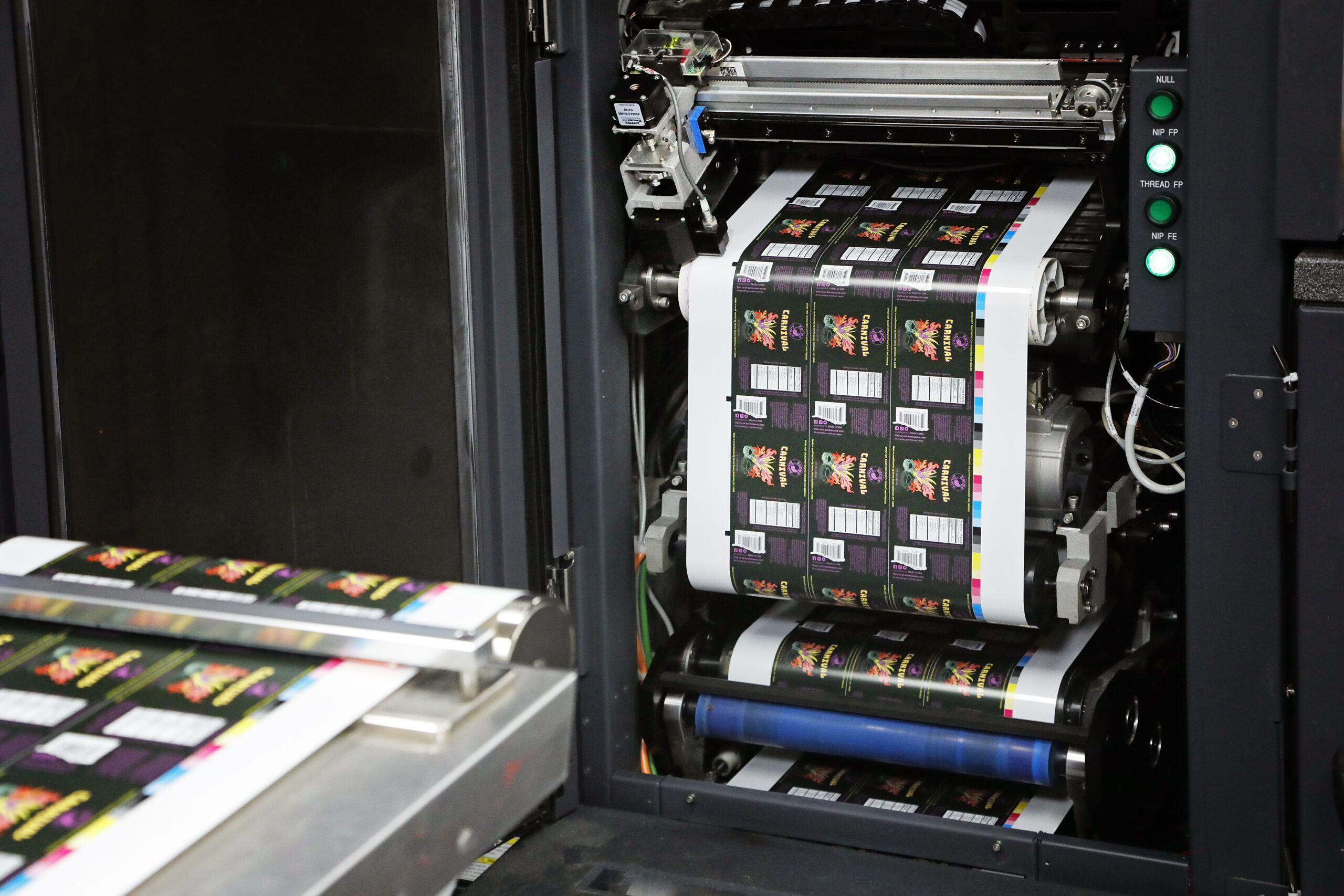
The Karma Sauce label represents three distinct technical capabilities that TLF Graphics brings together in a single print run: substrate selection, metallic layer application, and tactile surface treatment.
Silver BOP: The Foundation Material
Biaxially oriented polypropylene — BOP or BOPP in the label industry — is a film substrate stretched in two directions during manufacturing. That process makes it dimensionally stable, resistant to moisture, and capable of holding extremely fine print resolution. The silver variant provides a metallic base without requiring a separate foil stamp.
For hot sauce bottles that sit in refrigerators, on humid countertops, and ship through temperature swings, BOPP is the right material. It won’t curl, bubble, or delaminate under conditions that would compromise paper-based labels.
Metallic Layer Printing
TLF applied metallic layers over the silver BOP base to create the finished visual effect on the Karma Sauce label. Metallic printing requires precise ink layering and calibrated cure settings. Done correctly, it produces a label that catches light in a way that photographs well, films well, and reads as premium at shelf level.
This matters enormously in a retail environment where a shopper decides whether to pick up a bottle in under three seconds.
Raised Tactile Printing
The raised printing on the Karma Sauce label is a surface treatment applied after the base print run. It builds up selectively on specific areas of the label, creating a texture the consumer feels when handling the bottle. Tactile printing is used on premium products because it communicates craft and intentionality in a way that flat print cannot.
Most food brands treat label design as a cost center and label printing as a commodity. Brands that treat both as a competitive advantage — selecting materials, substrates, and surface treatments that reinforce the product’s positioning — consistently stand out on the shelf. The Karma Sauce label is a precise example of this in action.
What Should Food and Beverage Brands Know Before Choosing a Label Partner?
Selecting a label manufacturer is one of the decisions that shapes a product’s market performance more than most brands realize. The wrong choice shows up in spoiled runs, missed launch dates, and labels that don’t survive the shelf environment they were designed for.
Questions to Ask a Label Printer Before You Sign
Can you handle my substrate? Not all printers can process BOPP, foil, or paper substrates with equal quality. Ask for samples on your specific material before committing.
What’s your rush capacity? The Karma Sauce situation was a crisis, but rush orders are common. Ask how the printer handles last-minute demand before you need to find out under pressure.
What’s your minimum run? For emerging brands, high minimums create cash flow problems. For established brands, flexible runs allow seasonal and limited-edition labels without waste.
Do you have food and beverage industry experience? Labels for food products face specific regulatory requirements — ingredient statement formatting, net weight declarations, allergen callouts. A printer without food industry experience creates compliance risk.
Who is my point of contact? In a crisis, you need one person who knows your account and can make decisions. Not a ticket number.
TLF Graphics has served the food and beverage sector for 45 years and holds Allied Member status with the NYS Brewers Association. The Rochester, NY facility has been recognized as a Top 100 Company in the Rochester region 11 times since 1989.
FAQ: Custom Label Printing for Food and Beverage Brands
How long does it take to produce custom hot sauce labels?
Standard production timelines for custom hot sauce labels run 7 to 14 business days from approved artwork, depending on substrate, finish, and run quantity. Rush orders can shorten that window significantly when a manufacturer has available capacity and an established relationship with the client. TLF Graphics demonstrated this with the Karma Sauce Hot Ones order, delivering under emergency conditions when a previous vendor fell through. Brands with established accounts tend to receive faster emergency response than new clients.
What’s the difference between a metallic label and a standard printed label?
A standard printed label uses ink applied to a paper or film substrate. A metallic label adds reflective visual effects through one of three methods: a metallic substrate like silver BOP, a foil stamp layer applied after printing, or metallic inks. Each method produces a different visual outcome and requires different equipment. Silver BOP, as used on the Karma Sauce label, provides a consistent metallic base across the full label surface without the registered alignment requirements of foil stamping.
What is silver BOP material and why do premium brands use it?
Silver BOP stands for silver biaxially oriented polypropylene. The biaxial orientation process stretches the film in two directions, creating a substrate that is dimensionally stable, moisture-resistant, and capable of holding fine print detail. Premium food and beverage brands use it because it doesn’t curl or delaminate in humid or cold environments, holds metallic finishes without distortion, and photographs well for e-commerce and marketing content.
What does tactile or raised printing add to a label?
Raised printing builds up selectively on areas of the label surface, creating a three-dimensional texture the consumer can feel. The Karma Sauce label used this technique to reinforce a premium, handcrafted positioning. For artisan food brands competing in a crowded shelf environment, the physical sensation of quality is a meaningful differentiator that flat printing cannot replicate.
How do I know if a label manufacturer can handle regulatory requirements for food products?
Ask directly whether the printer has produced labels for FDA-regulated food products and whether they have staff familiar with food labeling regulations under 21 CFR Part 101. A capable food label manufacturer will understand net quantity declaration placement, required font sizes for nutritional information, and allergen statement formatting. They should be able to review your artwork file for obvious compliance issues before production begins, though final regulatory compliance remains the brand owner’s responsibility. Learn more at TLF’s customer resource center.
Ready to Print Labels That Win Awards?
Karma Sauce didn’t win Label of the Year by accident. They chose a substrate that catches light. They chose a surface treatment that communicates craft. They chose a manufacturer with 45 years of specialty label experience, 75 printing devices, and the operational flexibility to move their order to the front of the queue when a crisis hit.
The right hot sauce labels don’t just protect your product. They tell your story before anyone opens the bottle.
TLF Graphics is a specialty label manufacturer in Rochester, NY, with a 45-year track record across food, beverage, personal care, and industrial categories.
Contact TLF Graphics to discuss your next label project.
TLF Graphics Inc.
235 Metro Park, Rochester, NY 14623
(800) 356-2701 | sales@tlfgraphics.com
www.tlfgraphicsusa.com
Sources
- Karma Sauce / TLF Graphics case study video: https://www.youtube.com/watch?v=yG2LKnNGjSU
- All story facts (partnership date, Zestfest win, Hot Ones rescue, founding story) verified against this primary source.
- TLF Graphics company facts (employee count, device count, Rochester Top 100 recognition, address, contact) verified against tlfgraphicsusa.com public record.